
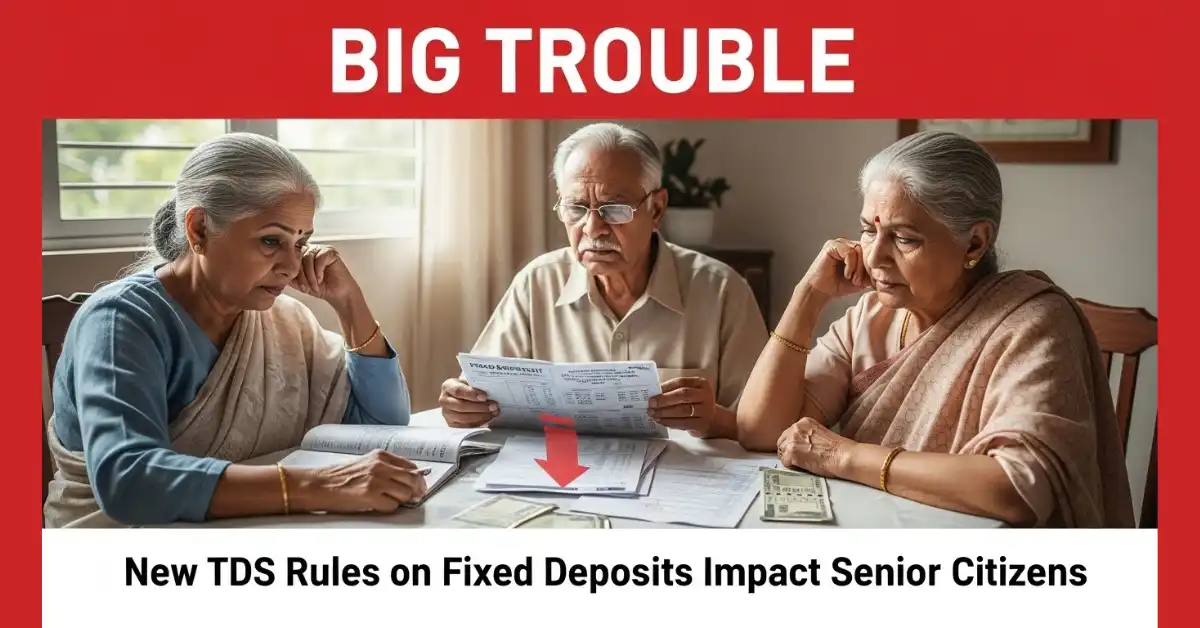
Starting January 1, 2026, millions of senior citizens across India will face a significant change in how Tax Deducted at Source (TDS) is applied on their fixed deposit (FD) interest income. Under revised Income Tax Department guidelines, banks will now deduct TDS at 10% on FD interest earnings even if the total annual interest is below ₹50,000, eliminating a key tax relief previously available to seniors. This move—part of the government’s broader 2026 compliance drive—could reduce net returns for over 3.2 crore elderly depositors relying on FDs for monthly income.
Know Complete Details
The new rule, effective from January 1, 2026, removes the earlier exemption that allowed senior citizens (aged 60+) to avoid TDS on FD interest up to ₹50,000 per year per bank. Now, regardless of age or total interest amount, any interest credited to an FD account will attract 10% TDS if Form 15G/15H is not submitted—even for interest as low as ₹10,000.
Key changes include:
- No threshold exemption: Earlier, seniors enjoyed TDS exemption up to ₹50,000 annually per bank. That ceiling no longer exists.
- Mandatory Form 15H: To avoid TDS, senior citizens must proactively submit Form 15H before interest is credited—banks will no longer remind customers.
- Pan card mandatory: Accounts without a linked PAN will face 20% TDS, double the standard rate.
How It Affects You
If you’re a senior citizen with one or more FDs:
- Your monthly interest payout may drop by 10% unless you’ve submitted Form 15H.
- Joint accounts: TDS will apply based on the primary account holder’s age and documentation.
- Multiple banks: The ₹50,000 limit was per bank—not total. Now, even small FDs in regional banks will attract TDS without proper paperwork.
For example: A 65-year-old with ₹10 lakh in an FD at 7% interest earns ₹70,000 annually. Earlier, they paid no TDS if they submitted Form 15H. Now, if they forget to submit it in January 2026, ₹7,000 will be deducted as TDS—reducing their effective return to 6.3%.
How to Avoid Trouble
To prevent unnecessary TDS deductions in 2026:
- Submit Form 15H immediately at your bank branch or via net banking—do this before January 10, 2026, for interest credited in January.
- Verify PAN linkage on all FD accounts—visit your bank or use the Income Tax e-Filing portal.
- Consolidate small FDs: Holding multiple small deposits across banks increases compliance risk. Consider merging them into fewer accounts.
- Track interest accrual: Use your bank’s FD tracker or mobile app to anticipate credit dates and submit forms in time.
💡 Pro Tip: Form 15H is valid only for one financial year. You must resubmit it every April—or earlier if opening a new FD.
Government’s Rationale
The Finance Ministry stated the change aims to “plug tax leakage” and align FD taxation with other income sources. “With digital tracking, we can now ensure uniform compliance,” said a senior official from the Central Board of Direct Taxes (CBDT). The move is also expected to boost advance tax collections ahead of the Union Budget 2026 in February.
Stay Protected in 2026
Don’t let outdated assumptions cost you money. If you’re over 60 and earn FD interest, act now:
- Visit your nearest bank branch
- Download Form 15H from the Income Tax India website (www.incometax.gov.in)
- Submit it online via your bank’s net banking portal
Comment below if you’ve already submitted Form 15H for 2026—or if you need help! Stay updated with ShouryaIndia.in for more government rule changes affecting your money.