
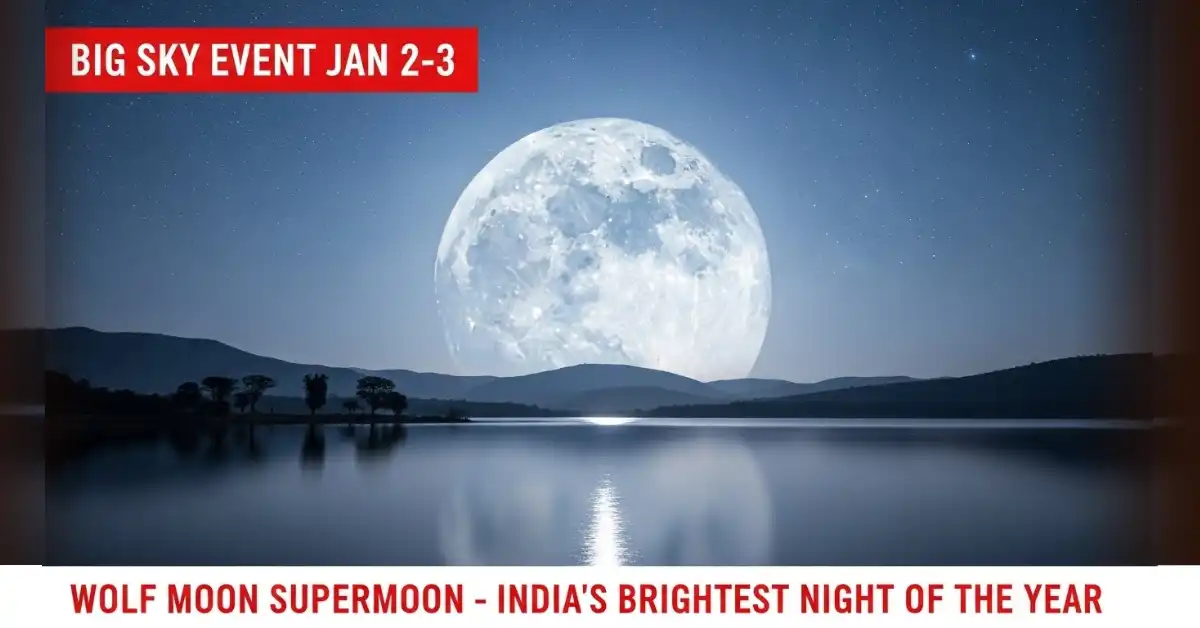
The Wolf Moon is the first full moon of 2026 and also qualifies as a supermoon—one of the brightest and largest full moons of the year. It peaks on the night of January 2–3, 2026, and will be clearly visible across India, making it a major astronomical highlight for skywatchers, photographers, and families alike. Here’s a complete, detailed guide covering what makes this event special, why it’s trending, viewing tips, cultural significance, and more.
1. What Is the Wolf Moon?
- Name Origin: Traditionally called the “Wolf Moon” by Native American tribes because wolves were heard howling more frequently during the cold January nights when food was scarce. Other names include “Cold Moon,” “Ice Moon,” or “Old Moon.”
- Supermoon Status: This full moon occurs when the Moon is at or near its perigee (closest point to Earth in its orbit). On January 2–3, 2026, the Moon will be about 14% larger and 30% brighter than an average full moon.
- Brightness & Size: It will appear noticeably bigger and more luminous than typical full moons, especially when low on the horizon (the “moon illusion” makes it look even larger).
2. Exact Timing in India (January 2–3, 2026)
The full moon moment is January 3, 2026, at 01:33 AM IST (Indian Standard Time).
- Best Viewing Window: From sunset on January 2 until sunrise on January 3. The moon will be visible all night and reach its highest point around midnight.
- Moonrise & Moonset (Major Cities):
- Delhi: Moonrise ~6:15 PM (Jan 2), Moonset ~8:00 AM (Jan 3)
- Mumbai: Moonrise ~6:20 PM, Moonset ~7:45 AM
- Bengaluru: Moonrise ~6:25 PM, Moonset ~7:35 AM
- Kolkata: Moonrise ~5:50 PM, Moonset ~7:20 AM
- Chennai: Moonrise ~6:10 PM, Moonset ~7:30 AM
(Exact times vary slightly by location—use apps like Stellarium or Sky Tonight for precise local data.)
3. Why Is This Supermoon Special in 2026?
- First and Brightest of the Year: This is the first supermoon of 2026 and one of only two or three for the entire year (the next is likely in November 2026).
- Perfect Timing: Occurs right after New Year celebrations—many people are still in a festive mood and looking for free outdoor events.
- Clear Winter Skies: January nights in most parts of India are often crisp and clear, offering excellent viewing conditions (except in foggy northern regions).
4. Viewing Tips for the Best Experience
- Location: Choose an open area with minimal light pollution—rooftops, parks, beaches, or countryside. Avoid city centers if possible.
- Timing: Look east at moonrise (around 6:00–6:30 PM on Jan 2) when the moon looks biggest due to the horizon effect. Stay out late for peak brightness around midnight.
- Equipment:
- Naked eye → Already stunning
- Smartphone → Use night mode + tripod for clear photos
- Binoculars or small telescope → See craters and maria (dark patches) in detail
- Weather Check: Clear skies are ideal. Check IMD or local weather apps for fog or cloud cover.
- Photography Tips: Use long exposure (5–15 seconds) on a tripod for sharp moon shots. Foreground elements (trees, temples, people) make dramatic silhouettes.
5. Cultural & Scientific Significance
- Indian Context: In Hindu tradition, the January full moon is called Paush Purnima. Many observe fasts, visit temples, or take holy dips in rivers. It’s also linked to the Lohri festival (Jan 13–14) in northern India.
- Scientific Angle: Supermoon occurs because the Moon’s elliptical orbit brings it 30,000–50,000 km closer than average. This increases tidal forces slightly (though no major impact on Earth).
- Astrology Buzz: Some astrologers are linking this bright moon to emotional intensity, new beginnings, and clarity—trending on social media.
6. Why Is It Trending So Much on Jan 2, 2026?
- Free & Accessible: No cost, no tickets—everyone can enjoy it from home or nearby.
- Social Media Fuel: People are already sharing moonrise photos, live streams, and viewing party plans.
- Post-New Year Mood: After fireworks and celebrations, stargazing is a calm, beautiful way to start the year.
- Last Supermoon Until November: This rarity adds urgency—people don’t want to miss it.
Quick Summary Table
| Aspect | Details |
|---|---|
| Date & Time | Jan 2–3, 2026; Full moon at 01:33 AM IST |
| Name | Wolf Moon (Supermoon) |
| Size & Brightness | ~14% larger, ~30% brighter than average |
| Best Viewing | Moonrise (6:00–6:30 PM) or midnight |
| Recommended Gear | Naked eye, smartphone with tripod, binoculars |
| Cultural Name (India) | Paush Purnima |
Don’t Miss It! Step outside tonight (January 2 evening) and look up—the Wolf Moon Supermoon will be one of the most beautiful sights of 2026.
Planning to photograph it or watch with family? Share your plans in the comments! 😊